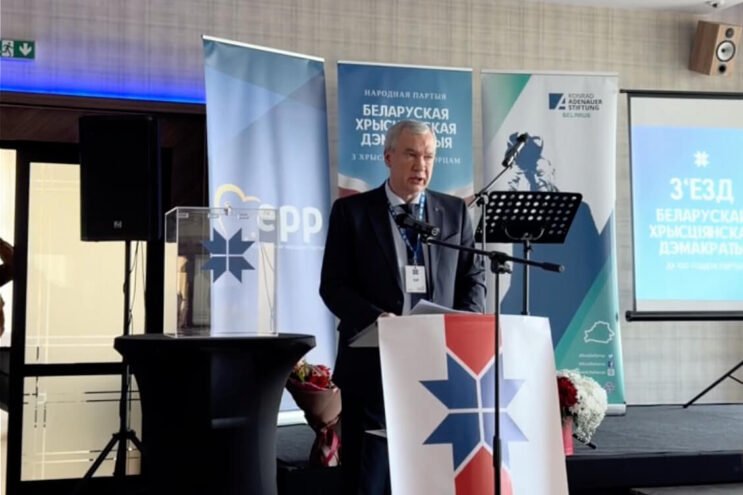
A congress was held in Białystok to mark the 100th anniversary of the Belarusian Christian Democracy (BCD), which, at the invitation of party leader Pavel Sevyarynets, was attended by Pavel Latushka, Deputy Head of the United Transitional Cabinet and a delegate of the Coordination Council.
During his opening address, he noted: “Belarusian Christian Democracy has endured the repressions of the 1930s, Soviet totalitarianism, and imprisonment under Lukashenka. But you have endured”.
Also participating in the congress were:
- member of the European Parliament and Vice-President of the European People’s Party Andrzej Halicki;
- head of the Konrad Adenauer Foundation’s office in Belarus Gabriele Baumann;
- chairman of the “Union of the Homeland – Lithuanian Christian Democrats” party, Laurynas Kasčiūnas;
- deputy of the Chamber of Deputies of the Parliament of the Czech Republic, Hayato Okamura;
- chief advisor to Sviatlana Tsikhanouskaya, Franak Vyačorka;
- member of the Council of the Belarusian People’s Republic and representative of the Belarusian minority in the Białystok Voivodeship Yevgen Vapa;
- official representative of the Christian Democratic Party of Norway Jon Steinar Kjeldsdal;
- diplomatic advisor to Sviatlana Tsikhanouskaya Denis Kuchynski;
- co-founder of the United Civic Party and the centrist-right coalition Anatol Lyabedzka;
- Deputy Representative for the Transfer of Power of the United Transitional Cabinet of Belarus, leader of the “For Freedom” Movement Yuri Gubarevich;
- civil society leader, political prisoner Zmitser Dashkevich;
- as well as representatives of the BNF Party, the Belarusian Social Democratic Party “Gromada,” and other parties.
During his speech, Pavel Latushka addressed Pavel Sevyarynts: “You have dedicated decades of your life to political struggle and service to Belarus. You endured long and difficult years of imprisonment, but you proved to the whole world that principles and moral strength are higher than any bars. Your resilience and your return to work are a huge inspiration to many. You are a role model for me and my colleagues”.
He also stressed that no political ambitions in exile make sense if we do not aim to return to Belarus: “Our common goal: to return home, achieve political change and free elections — and to participate in them in Belarus”.
Paweł Latushka proposed that the parties take an active part in the upcoming elections to the Coordination Council: “By combining party building with the development of a common representative body, we are doing what is classic and the foundation of any free democracy: when parties compete in elections and form the bodies of government. In this way, we will unite parties and institutions into a single fist and lay the foundation for the future political system of Belarus”.
His speech emphasized that today, for the first time, Belarusian democratic forces were able to build a full-fledged institutional architecture: “Separately we lose our strength, but when we unite our efforts and coordinate our actions—that is when we secure the political subjectivity of the Belarusian people. This is a powerful historical precedent: we have every opportunity to be not just the sum of individual political entities, but a single and powerful alternative system”.
Pavel Latushka also noted that the NAD prepared a study, “National Dialogue for Belarus”, which analyzed the experience of Germany, Poland, and Spain as possible models for exiting the crisis. The key conclusion of the document is this: a system can only engage in dialogue with another system. And only another system can defeat or change the system.
In conclusion, the politician added that our principle in relations with the EU remains unchanged: “Nothing about the Belarusian people without the Belarusian people themselves! The interests of the Belarusian people must be represented and defended by Belarusian democratic institutions and civil society. And it is from this fundamental principle that the Strategy of the Belarusian Round Table stems. This is not a concession to the regime. It is the only bridge that leads from repression and emigration to free elections and a return home”.